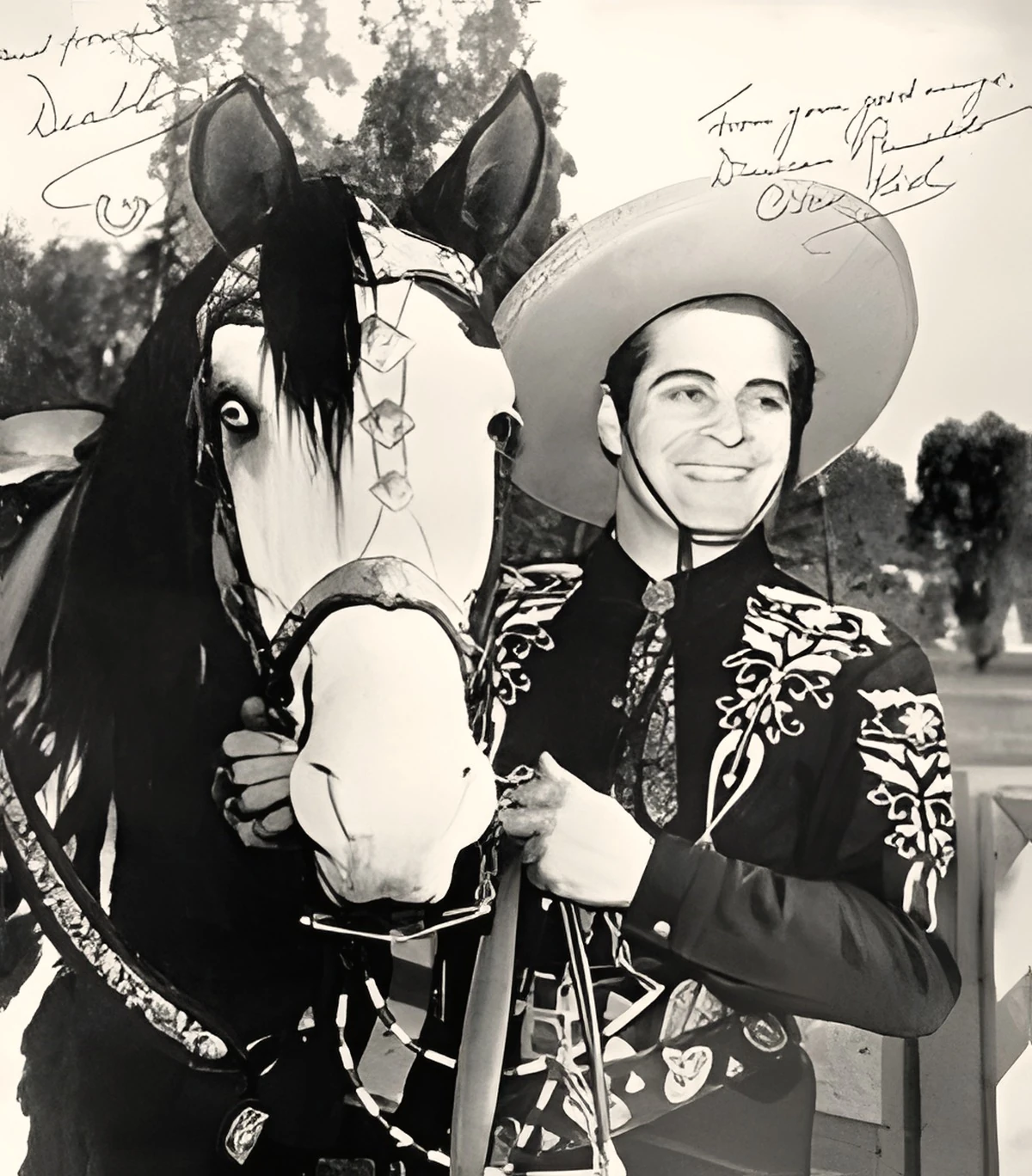
The Cisco Kid
The Character and What He Was
The Cisco Kid wasn't your standard Western hero. He was, as the show itself put it, "O. Henry's beloved badman who rides the romantic trail that leads sometimes to adventure, often to danger, but always to beautiful senoritas." That description doubles as a near-perfect preview of what the radio series delivered across its run: a Mexican outlaw and adventurer who robbed the rich and the greedy, stayed one step ahead of the law, and somehow found time at the end of every episode to collect a kiss from a dark-eyed senorita.
What makes this stranger is that O. Henry's original 1907 story, "The Caballero's Way," depicts the Kid as something else entirely — a blond Anglo desperado on the Texas-Mexico border, twenty-five years old, responsible for at least eighteen deaths, who kills for sport. The story's plot turns on the Kid tricking a Texas Ranger into shooting his own girlfriend by having her dress in his clothes, after which the Kid rides off singing. None of that survived the trip to radio. The 1928 sound film In Old Arizona had already transformed the character into a heroic Mexican caballero (Warner Baxter won the Academy Award for playing him), and the radio series inherited that version: a virtuous wanderer, a kind of quasi-Robin Hood, often mistaken for an outlaw because of his habit of tangling with the rich and the greedy.
Cisco was also, by the terms of the show, a genuinely formidable man — a fighter with both fists and guns who took the law's suspicion as a useful tool rather than a problem to be solved. A recurring plot device, noted by Radio Life magazine in 1947, had the sheriff and his posse convinced that Cisco and his partner Pancho were the criminals, while the pair deliberately played into that suspicion so the real outlaws would lower their guard. It was a neat trick that let the writers play both sides of the outlaw-hero coin at once.
His bond with Pancho was the emotional core of the show. Cisco called him "Chico," could scold him freely for some act of stupidity, and yet would not allow any other man to say a word against him. That combination of affectionate contempt and fierce loyalty gave the partnership real texture, and it sustained the show across more than a decade and several distinct production runs.
How It Got on the Air and Who Played It
The show premiered on Mutual on October 2, 1942, as a 30-minute program. Jackson Beck played Cisco in this first run, and Louis Sorin took the role of Pancho — described in the production as Cisco's comedic sidekick. The two traded an Americanized Mexican dialect throughout, with Pancho's lines rendered phonetically on the page: "Oh, Ceesco, perhaps they weel keel heem." Jock MacGregor directed, Michael Rye (also known as Rye Billsbury) announced, and the supporting cast drew from prominent New York radio talent, including Vicki Vola, Bryna Raeburn, and Mark Smith.
The Mutual run shifted time slots several times. It aired mostly on Fridays at 8:30 until January 1944, then moved to Saturdays at 8:30 until October of that year, then to Wednesdays at 9:30 before the network run closed out on February 14, 1945.
In 1946 the show surfaced again as a regional broadcast on Mutual-Don Lee, airing three times a week — Mondays, Wednesdays, and Fridays at 7:30 Pacific time. This version was produced by J. C. Lewis and written by Larry Hays. The casting changed: Jack Mather stepped into the Cisco role, with Harry Lang as Pancho. Radio Life's commentary in 1947 noted that the series had moved to California to be recast, and Mather and Lang carried the roles forward into the transcribed syndication that ran from 1947 to 1956 — by far the longest and most widely heard version of the show, producing somewhere north of six hundred episodes across nine years.
The Sound of the Thing
The opening was all momentum. Racing hoofbeats, then gunshots, then the urgent voices of the two men — Pancho crying "Ceesco! The she reef he ees getting closer!" and Cisco answering "Thees way, Pancho, vamanos!" It dropped you into the middle of a chase before the title had even finished landing.
The fight scenes in the Jack Mather syndication years were something of a genre unto themselves. Cisco and Pancho kept talking throughout the fisticuffs — narrating, exclaiming, bantering — in a way that has been compared to the B-movie Western in which the hero never loses his hat. By modern standards the effect reads as unintentionally comic, all breathless chatter over punching sound effects, but it gave the action sequences a loose, almost vaudevillian energy that fit the show's tone.
The closing was ritualized in the best possible way. Every episode ended with a senorita, and Cisco invariably collected a kiss. According to Radio Life, he offered each "dark-eyed conquest" a string of pearls said to have belonged to his "sainted mother" — a recurring bit of charming audacity — followed by the kiss. Then came dreamy organ music, and the senorita would breathe "Ooooooh, Cisco!" to which Cisco replied "Ooooooh, senorita!" The action would cut to the trail, horses named Diablo and Loco carrying the pair away, and then Pancho would deliver a terrible closing pun. Cisco's response was always some version of disgusted exasperation. The episode ended with Cisco calling out "Oh, PAN-CHO!" and Pancho answering "Oh, Ceesco!" — both of them dissolving into whooping laughter as the horses galloped off. It was the kind of sign-off listeners could anticipate from the first time they heard it, which is probably why it held for the entire run.
The Men Behind the Voices
Jackson Beck, the original Cisco, was a Manhattan-born actor (July 23, 1912) whose father Max Beck had worked Broadway and silent film. He'd been in radio since 1931, starting at WINS and WHN, and by 1934 was announcing The Adventures of Babe Ruth. While he was riding the romantic trail on Mutual, he was simultaneously narrating The Adventures of Superman — the man delivering "strange visitor from another planet" was the same one shouting "Thees way, Pancho, vamanos!" He was a founding member of the American Federation of Radio Artists (later AFTRA), got a star on the Hollywood Walk of Fame in 1984, and was inducted into the National Radio Hall of Fame in 1999. He died in 2004, five days after his 92nd birthday.
Jack Mather, who carried the role through the long syndication years, came out of a farm outside Chicago (born September 7, 1907) and studied broadcasting at the University of Illinois. Before Cisco he'd been a regular on Gene Autry's Melody Ranch and turned up on the Bob Hope show, and he had a parallel career as a cartoon voice — he was the original Wally Walrus in Walter Lantz's Woody Woodpecker shorts. His radio credits ran across the dial: Suspense, Lux Radio Theatre, The Whistler, Inner Sanctum, Fibber McGee and Molly. In the show's later years he doubled as its announcer. He died of a heart attack in 1966.
Harry Lang, the syndication-era Pancho, had been a vaudeville headliner before radio with an act called Harry Lang and His Lid-Lifters, which toured the world. He spent the 1940s and early 1950s providing vocal effects for Tom in the MGM Tom and Jerry cartoons, occasionally voicing the cat outright. In early 1953 his heart began to fail, and he was forced to leave the show; the writers covered the absence with a storyline in which Pancho contracted measles, mumps, and chicken pox in rapid succession. Lang asked his close friend Mel Blanc to fill in, and Blanc agreed on the condition that his wages be sent to Lang for the duration. Blanc started by playing Pancho's cousin-in-law Porfirio in an accent borrowed from his own Pedro character before sliding into Pancho proper. Lang made a brief return before dying of a heart attack at his Hollywood home on August 5, 1953; Blanc carried Pancho the rest of the way to 1956.
The Long Afterlife
The Cisco Kid moved to television in 1950 with Duncan Renaldo as Cisco and Leo Carrillo as Pancho, produced by Frederick W. Ziv for Ziv Television Programs. It ran 156 half-hour episodes across six seasons through March 1956, and it has a footnote in broadcast history: it was the first American television series filmed entirely in color, originally shot in 16mm Kodachrome. Most viewers didn't actually see it in color until the 1960s, since few owned color sets during the original run. Renaldo and Carrillo have another distinction — Television Academy Interviews identifies them as the first regular Hispanic stars of an American television series, with Desi Arnaz reaching the air a year later in I Love Lucy.
The character kept showing up in other corners of American culture. Dell Comics published 41 issues between 1950 and 1958. A King Features newspaper strip drawn by José Luis Salinas and written by Rod Reed ran from 1951 to 1967. In 1973, the funk band War scored a number-two Billboard hit with "The Cisco Kid," held off the top spot only by "Tie a Yellow Ribbon Round the Ole Oak Tree"; guitarist Howard Scott, who sang lead, said the song was inspired by the TV character because Cisco was the only ethnic hero on television at the time, the only one he could really relate to. Members of the band met Duncan Renaldo at his home in Camarillo while recording the tribute. Janet Jackson sampled the song in 1997. Stephen King nicknamed two doomed characters Pancho and Cisco in "The Raft." A 1994 TV movie with Jimmy Smits and Cheech Marin closed with the traditional "Oh, Pancho! / Oh, Cisco!" exchange — proof that the sign-off had outlived the medium it was built for by close to forty years.
Roughly 160 episodes of the Mather syndication run are known to survive out of the six-hundred-plus that were produced. It's enough to get a clear sense of the show: the chase, the caper, the senorita, the terrible pun, the laughter, the galloping horses.